
Costs and pricing
Part of PR agencies costs and pricing: building a budget that measures real value
A blank PR budget template with approval gates that are not about money
A blank PR budget template for England, covering agency scope, tools, production, buyer labour, assurance, VAT, uncertainty, approval and exit.
This PR agencies budget template is intentionally blank. It gives an England buyer a structure for comparing planned, committed and actual cost. Fill it only from authorised quotations, signed terms, invoices, time records and finance-approved assumptions.
What to take away
- A blank PR budget template forces buyers to build cost from authorised quotations rather than an invented average fee, because no public England-wide figure fits every agency scope.
- Record change reason, approver and date for every approved revision.
- Keep initial estimate, approved budget, committed, invoiced and forecast columns visible so revisions stay traceable.
- Contingency needs an event trigger, evidence owner, maximum authority and release decision, not an automatic percentage.
- Non-financial gates need a named owner and a stop rule before the budget is ready.
Identification block
Record the buyer legal entity, agency legal entity, service territory, contract version, budget owner, finance owner, service owner, start and end dates, currency, VAT-review status and approval date. Add the do-nothing or in-house baseline. A brand name or informal scope is not enough to support payment.
Store the completed template with the contract record in the finance system. The budget owner signs the approval date; the finance owner countersigns.
Identification block fields
- Buyer and agency legal entities
- Service territory and contract version
- Budget, finance and service owners
- Start and end dates, currency
- VAT-review status and approval date
- Do-nothing or in-house baseline
Cost rows
Use one row for each cost driver:
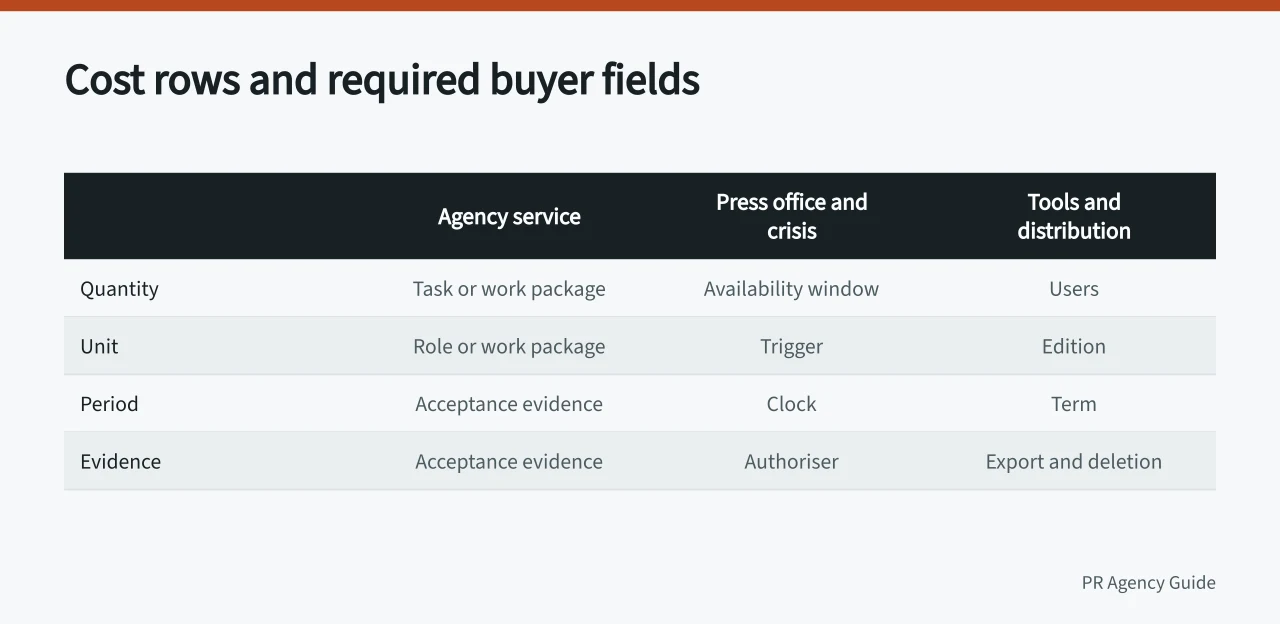
| Category | Required buyer fields |
|---|---|
| Agency service | Task, role or work package, quantity, unit, period, acceptance evidence |
| Press office and crisis capacity | Availability window, trigger, authoriser, clock, unused treatment |
| Tools and distribution | Exact service, edition, users, coverage, term, renewal, export and deletion |
| Research and monitoring | Population or source set, method, volume, rights and deliverable |
| Paid or creator activity | Placement, production, disclosure owner, rights, media amount and agency charge |
| Buyer labour | Named function, recorded hours, finance-approved loaded rate and displaced work |
| Assurance | Accessibility, legal, privacy, PECR, security, advertising and sector review |
| Travel and production | Authorised quantity, unit, supplier evidence, cancellation and expense policy |
| Correction and incident work | Trigger, response authority, evidence, cap and recovery path |
| Exit | Handover, archive, access removal, export, deletion, licence closure and continuity |
Every monetary cell needs currency, net or gross status, VAT shown, billing period, quantity, inclusions, exclusions, source URL or document, source date and confidence. Do not convert a foreign currency unless finance records the exchange-rate source and date.
Version columns
Place five columns beside the cost rows: initial estimate, approved budget, committed amount, invoiced or accrued amount, and current forecast. Keep the original values visible when a revision is approved. Record change reason, approver, date and the evidence replaced.
Version columns and reconciliation
- Initial estimatefirst recorded value
- Approved budgetafter approval
- Committed amountafter commitment
- Invoiced or accruedactual amount
- Current forecastlatest view
Add a reconciliation status beside each actual amount: unmatched, matched, disputed, credited or closed. A dashboard total should never conceal an unresolved invoice line. The finance owner sets the review interval and defines which variance, missing artefact or late approval pauses new commitments.
A typical stop rule is a forecast variance above 10% of approved budget with no signed change note; this pauses new commitments until the finance owner and budget owner approve.
Copy the table below into a spreadsheet or document. Leave the money cells blank until each row has a source.
| Cost row | Initial estimate | Approved budget | Committed | Invoiced or accrued | Current forecast |
|---|---|---|---|---|---|
| Agency service | |||||
| Press office and crisis capacity | |||||
| Tools and distribution | |||||
| Research and monitoring | |||||
| Paid or creator activity | |||||
| Buyer labour | |||||
| Assurance | |||||
| Travel and production | |||||
| Correction and incident work | |||||
| Exit |
Worked example row, using placeholders and the public 20% VAT rate, not a public benchmark:
| Cost row | Initial estimate | Approved budget | Committed | Invoiced or accrued | Current forecast |
|---|---|---|---|---|---|
| Agency service, 12 months | Leave blank until quoted | Signed monthly net charge | Signed monthly net charge x 12 | Accepted months x signed monthly net charge | Remaining months x signed monthly net charge |
If VAT applies at the standard 20% rate, the gross cash requirement includes the VAT on each invoice.
HMRC's VAT record guidance identifies records for sales, purchases, invoices and adjustments. It applies in its UK tax context and does not settle the treatment of this buyer's supply. Retain gross cash, net amount and possible recovery as separate columns until a qualified reviewer decides the position.
Formula sheet
Leave all variables empty:
approved net external cost = sum(accepted quantity x approved net unit charge) + fixed net charges
cash requirement = external net cost + confirmed VAT cash effect - approved credits
internal economic cost = sum(recorded internal hours x finance-approved loaded rate)
full economic cost = finance-approved external cost + internal economic cost + other buyer resources
Do not treat contingency as an automatic percentage. Give each contingent row an event trigger, evidence owner, maximum authority and release decision.
Non-financial approval gates
The spreadsheet should not average away mandatory failures. The NCSC supply-chain review guidance supports ongoing assurance and reporting for suppliers, while the ICO lists processor-contract subjects such as instructions, security, subprocessors and return or deletion. Neither source proves that a particular agency passes.
Add independent go, hold or stop cells for privacy, PECR, security, accessibility, rights, advertising, regulated-sector, procurement, contract, finance and tax review. The budget is not ready while a required owner, source, unit or stop rule remains blank.
| Gate | Required owner | Stop rule |
|---|---|---|
| Privacy | Data protection lead or legal | No approved privacy review, no commitment |
| PECR | Marketing compliance owner | No PECR sign-off, no commitment |
| Security | Security lead | No security assessment, no commitment |
| Accessibility | Accessibility lead | No accessibility sign-off, no commitment |
| Rights | Rights manager | No rights clearance, no commitment |
| Advertising | Advertising compliance lead | No advertising sign-off, no commitment |
| Regulated-sector | Sector compliance lead | No sector approval, no commitment |
| Procurement | Procurement lead | No procurement approval, no commitment |
| Contract | Legal counsel | No signed contract, no commitment |
| Finance | Finance owner | No finance approval, no commitment |
| Tax | Tax adviser | No tax review, no commitment |
Before you act
- Fill the identification block from signed terms and finance-approved assumptions.
- Add reconciliation status beside each actual amount.
- Leave all formula variables empty until finance approves them.
- Record change reason, approver and date for every approved revision.
- Add independent go, hold or stop cells for each review area.
Common questions
Can a buyer fill the template before finance signs?
No. Fill the identification block and cost rows from authorised documents, but leave formula variables and approval gates empty until the finance owner and budget owner sign.