
Operations
A PR quality checklist that records the inspection, not just the tick
An evidence-based PR quality checklist for England, testing authority, substantiation, data, rights, accessibility, security, correction and exit.
This PR agencies quality checklist uses observable evidence rather than taste or media volume. Apply it to one work item for a client operating in England. Every required gate passes independently; a strong draft cannot offset a privacy, rights or security failure.
What to take away
- A strong draft cannot offset a privacy, rights or security failure, so each required gate must pass independently.
- Record the inspection itself, not just the tick, with inspector, date, work-item identifier, evidence location, version and result.
- A blank box is unresolved, not a quiet pass, and a failed item stays in its current state until restart is authorised.
- Retain failures as learning evidence and pause the shared source, template or process when the same failure recurs.
- A historical pass does not travel automatically to a changed configuration, so review the checklist after any material change.
This PR quality checklist records the inspection, not just the tick, so the regulator block below sets out what each named instrument does and does not clear.
- The Committee of Advertising Practice (CAP) writes the UK advertising codes. It covers paid and promotional claims within its remit. It does not clear editorial copy, organic PR or every client claim.
- The Competition and Markets Authority (CMA) enforces consumer protection law on misleading commercial practices. It does not approve an article as independent editorial.
- The Information Commissioner's Office (ICO) enforces UK GDPR and the Privacy and Electronic Communications Regulations (PECR). It does not authorise a contact list or outreach channel in advance.
- The government IP agreements guide supports explicit licence fields. It does not transfer ownership or grant permission for a specific asset.
Authority and source control
- The client legal entity and authorised factual owner are named.
- Every objective proposition links to dated evidence, scope and an expiry or recheck trigger.
- Opinion, quotation, inference, current fact and scenario are visibly different.
- The released file matches the version approved by the client.
For advertising within CAP's remit, the substantiation rules provide the basis for checking documentary support. They do not clear a claim or make the same rule apply to every editorial pitch.
Authority and source control
- Client legal entity and factual owner named
- Objective propositions link to dated evidence
- Opinion, quotation, inference, fact visibly different
- Released file matches approved version
Media route and commercial recognition
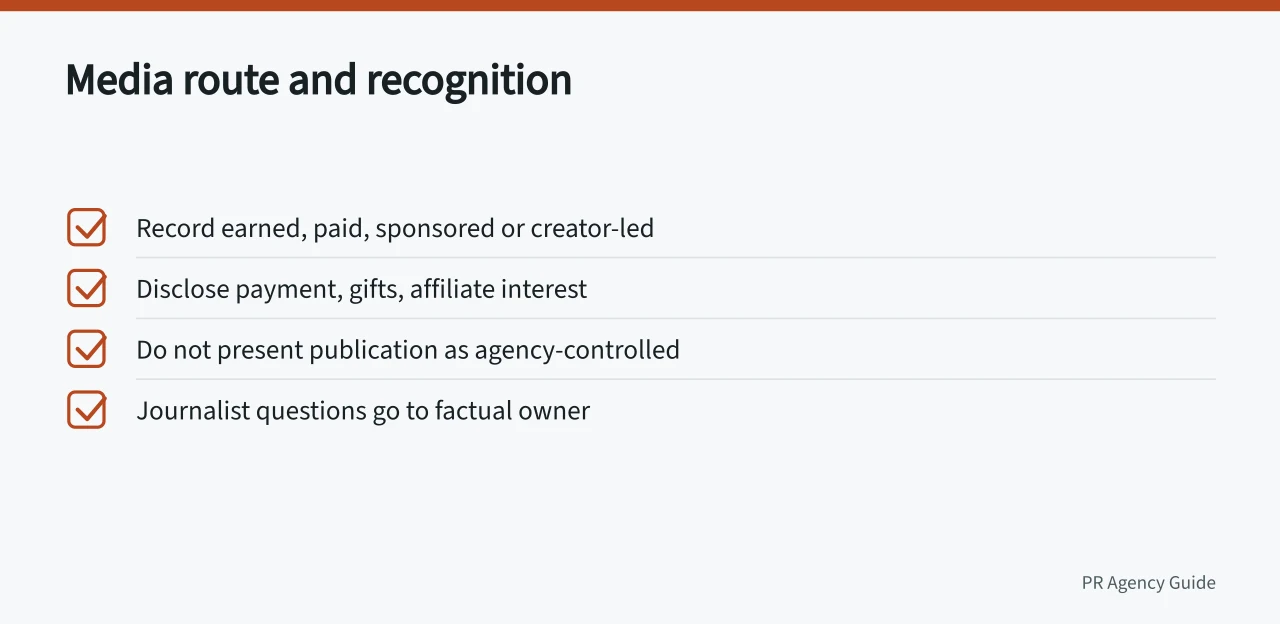
- The record states whether the item is earned editorial, paid, sponsored, creator-led, direct marketing or marketer-controlled.
- Payment, gifts, affiliate interest and agency involvement are disclosed through the approved route.
- Publication, headline, tone and timing are not presented as agency-controlled outcomes.
- A question from a journalist goes to the factual owner without pressure to adopt the client's framing.
The CMA's endorsements guidance for brands covers recognisable incentivised content in its UK consumer context. It is not a universal label or evidence that an article is independent.
Contact data and outreach
- Each personal-data field has a source, purpose, recipient type, channel and review date.
- Transparency, objection and suppression evidence travels with the contact.
- A corporate address is not silently reclassified as an individual subscriber, or vice versa.
- An editorial approach is not reused for later marketing without a new assessment.
The ICO's B2B marketing page explains why recipient and channel facts matter. A data protection officer or a solicitor with UK GDPR and PECR expertise must decide the actual activity.
Assets and accessibility
- Copy, photographs, video, recordings, quotations and monitoring material have traceable rights.
- Licences state permitted users, uses, territory, duration, credit and expiry.
- Required captions, transcripts, document structure and alternative formats share the approved facts.
- Evidence records the actual accessibility tasks and tools used, plus unresolved defects.
The government IP agreements guide supports explicit licence fields. It neither transfers ownership nor supplies permission for a specific asset.
Security, correction and closure
- Access is limited, leavers are removed and confidential material is separated by matter.
- An incident record names containment, evidence, notification, recovery and restart owners.
- A correction ticket identifies every affected version and channel without erasing the original.
- Charges reconcile to accepted work and authorised expenses.
- Exit covers open enquiries, archive, export, access removal, deletion evidence and continuity.
For a failed item, the quality owner records what evidence is missing, who can resolve it and who may authorise restart. This draft remains HOLD. The quality owner may lift this HOLD only on written evidence.
A data protection officer or solicitor with UK GDPR and PECR expertise, a rights reviewer, and the client's authorised factual owner must have tested the checklist on real or properly authorised fixtures.
Record the inspection, not just the tick
Use pass, hold, stop or not applicable; require a reason and approving owner for the last category.
The quality owner selects the inspection population before seeing results. For a small batch, the buyer may require review of every item. For a larger flow, any sampling rule must state the eligible population, selection method, period, exclusions and escalation from a failed sample. This guide supplies no sample size or acceptable defect rate.
Retain failures as learning evidence. Record containment, correction, root-cause review, affected items and the exact proof needed for restart. Do not erase the original artefact when a revised version passes. If the same failure appears across different work items, pause the shared source, template or process until its owner determines the scope.
Review the checklist after a new channel, supplier, client sector, data source, rights arrangement or accessibility requirement enters the service. A historical pass does not travel automatically to the changed configuration.
Before you act
- Confirm that every gate above has a named owner and a recorded evidence location.
- Resolve any item marked hold or stop before release.
Common questions
What must each checklist box record?
Each box carries the inspection record set out in the first takeaway. The record section above sets out the status options and the approving owner requirement.
How should a failed item be handled?
The quality owner records what evidence is missing, who can resolve it and who may authorise restart. Retain failures as learning evidence.
When should the checklist be reviewed?
Review it after a new channel, supplier, client sector, data source, rights arrangement or accessibility requirement enters the service. A historical pass does not travel automatically to the changed configuration, so the checklist must be reassessed against the new setup.