
Tools and providers
Part of PR tools and providers for agencies: a 2027 guide to workflow fit and data provenance
Rolling out PR software in an agency: a reversible method
PR software tool implementation for an agency in England: test tenancy, access, synthetic testing, UK GDPR records and DPIA, migration checks and rollback.
PR agencies tool implementation should start in an empty test tenancy. Loading a live media list first makes it harder to distinguish a configuration fault from a data, permission or licence problem. For an agency working in England, the initial objective is a reversible contact-to-correction path, not a campaign launch. The sequence is platform-agnostic: it is written for the software a PR agency typically rolls out, media-monitoring, media-database and distribution products such as Cision, Meltwater, Prowly, Muck Rack and Vuelio, and general CRM suites adapted for PR work, rather than for one vendor's setup wizard. Ask the chosen supplier to map each step below to its own test tenancy, export and deletion features before the order is signed.
Whatever the product, the sequence needs supplier, legal and operational revalidation against the signed order before use.
What to take away
- Start implementation in an empty test tenancy to isolate configuration faults from data or permission problems.
- Name all owners and keep evidence in a buyer-accessible repository, not only the supplier's project board.
- Build a synthetic case with invented data to test the full contact-to-correction path without contacting real people.
- Migrate only accepted records with provenance and reconciliation, and rehearse rollback before any live use.
- Release in a narrow lane only after every non-compensating gate passes, and monitor different event types.
Establish the owners and evidence store
Name the buyer sponsor, contract owner, agency service owner, privacy lead, security lead, accessibility reviewer, IP reviewer and rollback authority. Keep the signed order, configuration decisions, test results and exceptions in a buyer-accessible repository. The supplier's project board must not be the only record.
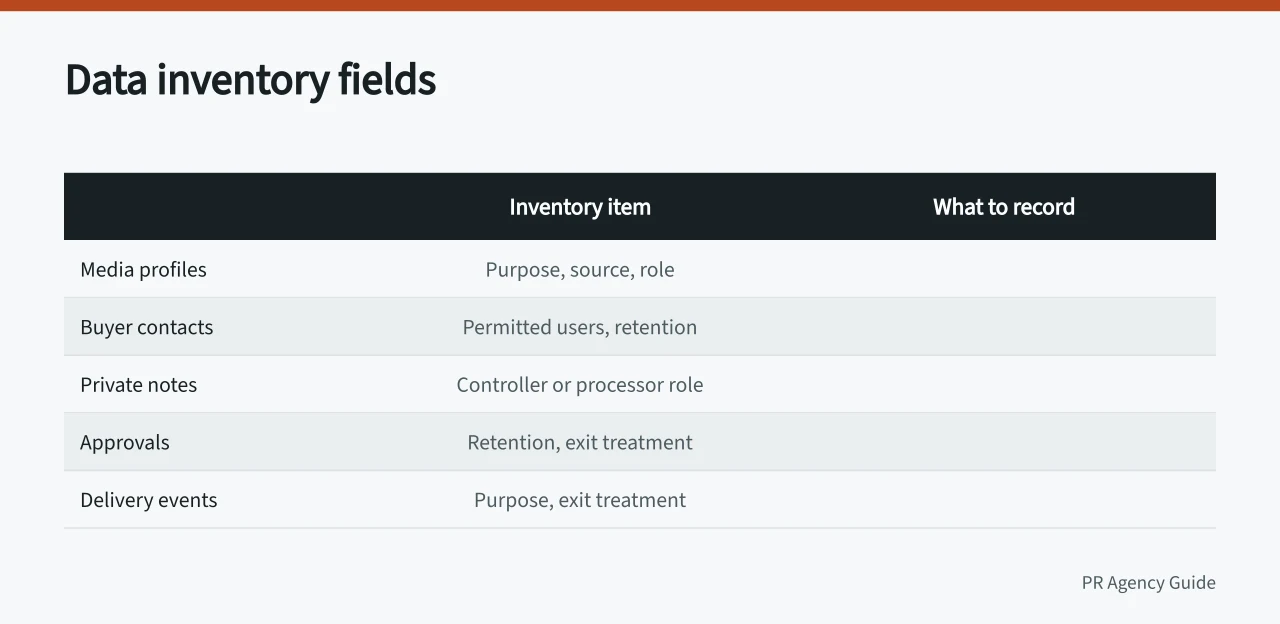
Create a data inventory for media profiles, buyer contacts, private notes, pitch copy, attachments, approvals, delivery events, replies and reports. For each item, record why it is needed, the source, factual controller or processor role, permitted users, retention and exit treatment. The UK GDPR and the Data Protection Act 2018 govern this work, and the ICO controller and processor guidance requires an activity-based assessment rather than a conclusion from job titles.
The inventory also feeds two documents the agency owes under UK GDPR. The first is its record of processing activities under Article 30: according to the ICO's guidance on who needs to document processing, organisations with 250 or more employees must document all their processing activities, and smaller ones must still document processing that is not occasional, which a media list used every week is not. The second is a data protection impact assessment: Article 35(1) requires a DPIA where a type of processing, in particular using new technologies, is likely to result in a high risk to individuals, so decide and record whether the new platform meets that test before live data goes in.
The incident route belongs in the same file. If a personal data breach is likely to risk people's rights and freedoms, the ICO must be notified as soon as possible and, where feasible, within 72 hours, so the rollback rehearsal below should show who would make that report.
Configure access before content
Connect the tenancy to the buyer's approved identity route where supported. Give administrators separate accounts, grant the least access needed, and document client-workspace boundaries. Test a joiner, a role change, a leaver and an emergency revocation.
Access configuration order
- Connect tenancy to approved identity route
- Give administrators separate accounts
- Grant least access needed
- Document client-workspace boundaries
- Test joiner, role change, leaver, revocation
The NCSC's SaaS security guidance covers managed identity, onboarding, offboarding, administration, incident monitoring and recovery. It also makes the customer responsible for its configuration. Record which control belongs to the supplier and which remains with the agency or buyer.
Build a synthetic case
Use invented organisations and addresses that cannot reach real people. Include a duplicate contact, a contested source, an objection, an approval expiry, an unauthorised attachment and a changed client fact. Walk the case through research, qualification, approval, scheduling, suppression, correction and export.
At each state, capture the permitted input, expected output, named approver, audit event and failure queue. A scheduled message must not proceed when the privacy route, claim approval, licence or recipient status is unresolved. Do not test deliverability by sending to a journalist.
Accessibility testing should follow the same work, not a separate homepage tour. Complete search, profile review, list editing and approval using keyboard and relevant assistive technology. Then cover error recovery and export the same way.
The government's technology accessibility guidance, scoped to government programmes, offers a useful procurement model: precise standards and test evidence. The benchmarks to cite are WCAG 2.2, at the stated conformance level, and EN 301 549 for procurement in the UK public sector. A qualified reviewer should set requirements for the actual organisation and users.
Migrate only accepted records
Quarantine any legacy spreadsheet or client database. Map each source field to the new schema, retain provenance and original timestamps where permitted, and reject records without the buyer's required evidence. Deduplicate without discarding objections, corrections or approval history.
Run a reconciliation before release: records offered, rejected, transformed, imported and still unresolved. Counts alone do not prove the correct records survived. Sample the difficult states and have the data owner sign the exception list.
Rehearse failure and rollback
Simulate loss of supplier access, accidental privilege, a stale media profile, a late correction and an incident notification. Confirm who pauses sends, preserves evidence, contacts affected parties, restores service and authorises restart. Leave service levels blank unless the signed contract supplies their event, clock, exclusions and remedy.
Before any live use, export the synthetic case to the buyer's required format. Check content, provenance, suppression, approvals and audit dates after reopening it outside the platform. Remove all test users and request the documented deletion route. If export is incomplete or a critical control cannot be demonstrated, roll back to the controlled manual process.
Release in a narrow lane
Allow a limited, permissioned workflow only after every non-compensating gate passes. The gates are non-compensating: a later pass never covers an earlier failure, and each one has to stand on its own.
- Named owners, including the rollback authority, with evidence held in a buyer-accessible repository.
- A completed data inventory covering profiles, notes, approvals and delivery events, with roles, retention and exit treatment recorded.
- Access configured on the buyer's approved identity route, with joiner, role change, leaver and emergency revocation tested.
- A synthetic case walked through research, qualification, approval, scheduling, suppression, correction and export without contacting real people.
- Accessibility testing completed on search, profile review, list editing, approval, error recovery and export.
- Reconciliation counts reviewed, difficult states sampled and the exception list signed by the data owner.
- Rollback rehearsed and the synthetic case exported and verified after reopening outside the platform.
Monitor access, failed sends, objections, corrections, incidents and configuration changes as different events. Hold expansion when a supplier change, unresolved complaint, accessibility defect or evidence expiry alters the decision. The 2027 review should repeat the task tests, not merely renew the licence.
Before you act
- Name buyer sponsor, contract owner, privacy lead and rollback authority.
- Create a data inventory covering profiles, notes, approvals and delivery events.
- Configure access and test joiner, role change, leaver and emergency revocation.
- Build a synthetic case with invented organisations and addresses.
- Migrate only accepted records and reconcile before release.
- Rehearse failure and rollback, then export the synthetic case.
Common questions
Why should PR software implementation start in an empty test tenancy?
An empty test tenancy makes it easier to distinguish a configuration fault from a data, permission or licence problem. Loading a live media list first makes that distinction harder, so the initial objective is a reversible contact-to-correction path, not a campaign launch.
What should be included in a synthetic case for testing?
A synthetic case should use invented organisations and addresses that cannot reach real people. It should include a duplicate contact, a contested source, an objection, an approval expiry, an unauthorised attachment and a changed client fact, then walk through research, qualification, approval, scheduling, suppression, correction and export.
When should an agency roll back to the controlled manual process?
Roll back if export is incomplete or a critical control cannot be demonstrated. Before any live use, export the synthetic case, check content, provenance, suppression, approvals and audit dates after reopening outside the platform, remove all test users and request the documented deletion route.