
Rules and ethics
FCA financial promotions rules for PR agencies working with UK banks
A public relations firm must apply FCA financial promotions rules, s21 approval, COBS 4.2 and Consumer Duty before any bank client signs off copy.
What to take away
- A public relations firm that writes, approves or shares promotional copy for a UK bank is inside the FCA financial promotion regime, even when the work looks like editorial or social content.
- COBS 4.2 requires every promotion to be fair, clear and not misleading, judged on the overall impression a retail client takes away.
- The s21 approval route lets an authorised person approve a promotion for an unauthorised bank or fintech, and the approver carries the regulatory risk.
- Consumer Duty adds a consumer understanding test that runs alongside COBS 4 for retail banking clients.
- Agencies should use a pre-sign-off checklist and keep records that show who approved what, when and against which rule.
What counts as a financial promotion under the FCA regime
The FCA financial promotion regime turns on one question: is this an invitation or inducement to engage in investment activity, communicated in the course of business? If yes, the promotion must be made or approved by an authorised person unless an exemption applies.
Is it a financial promotion?
Invitation or inducement to invest?
needs authorised approval
usually not a promotion
That definition reaches press releases, thought leadership, paid social posts and landing pages when they invite a UK audience to buy, save, invest, borrow or transfer.
For a public relations firm, the practical risk sits in content that a client treats as brand awareness. A bank can ask an agency to draft a commentary piece about a new savings rate, and the brief to the agency should say whether the piece carries a call to action. If the piece ends with a call to open an account, it is a financial promotion.
If it merely reports a market trend with no inducement, it usually is not. The line is not the format. It is the intent and the call to action.
A dated map of regulations helps an agency see where FCA rules sit alongside the CAP Code, UK GDPR and the rest of the UK framework. The COBS 4 communication rules set out what authorised firms must follow for investment promotions, so agency copy written for them must meet the same standard from the first draft onwards. Deposit and credit products use BCOBS 2 and CONC 3 instead, covered below.
The three routes to compliance
A promotion reaches the market in one of three ways. First, an authorised firm communicates it itself. Second, an unauthorised firm has it approved by an authorised person under section 21 of the Financial Services and Markets Act 2000. Third, an exemption applies, such as the exemptions for certain high net worth or sophisticated investors. These sit in the Financial Services and Markets Act 2000 (Financial Promotion) Order 2005, which sets conditions for each exemption.
Most agency work for banks sits in the first route because the bank is authorised and signs off its own copy. The second route matters when the client is an unauthorised fintech, a payment institution or an overseas bank without UK authorisation. The agency then needs an approval arrangement in place before any copy goes live.
Where agencies get caught out
Agency teams get caught out by three habits. They treat a client approval email as a compliance approval, when the contract terms should say who approves what. They let a creative director rewrite a headline after legal sign-off. They publish a case study that names a client's product without checking the client's own approval record.
Each of these creates a gap between what the FCA expects and what the file shows. The stakes are real: communicating a financial promotion in breach of section 21 is a criminal offence under section 25 of the Act, and agreements that follow an unlawful promotion can be unenforceable under section 30. The fix is procedural, not creative. Build the approval step into the production schedule so no one can publish around it.
What is not a financial promotion
Some output sits outside the regime. A recruitment advert for a bank's graduate scheme is not a financial promotion. A corporate announcement about a board appointment is not one either. Neither is a factual news story with no inducement.
The test is whether the communication invites or induces. A press release that says a bank has opened a new branch is factual. The same release with a line urging readers to switch their current account is promotional. Agencies should flag the difference in the brief, not after publication.
COBS 4.2 fair, clear and not misleading: the standard for bank clients
The fair, clear and not misleading standard for financial promotions is the core test in COBS 4.2 standard. The rule is COBS 4.2.1R: a firm must ensure that a communication or financial promotion is fair, clear and not misleading. It applies to every communication with a retail client, whether the agency writes it or the bank does. What matters is the general effect, not simply each separate sentence.
Headline versus overall impression
Compliant
- Headline claim
- rate stated
- Qualification
- next to claim
- Bonus period
- disclosed upfront
- Risk balance
- upside and risk
- Reader takeaway
- accurate impression
Breach
- Headline claim
- high rate only
- Qualification
- buried in small print
- Bonus period
- hidden 12 months
- Risk balance
- upside only
- Reader takeaway
- false impression
Banking products: BCOBS 2 and CONC 3
COBS applies to investment business. A bank's deposit products, such as current accounts and savings, fall under BCOBS 2, the Banking Conduct of Business sourcebook. BCOBS 2.2.1R requires firms to take reasonable steps to ensure that communications and financial promotions are fair, clear and not misleading.
Consumer credit promotions, such as loans and cards, fall under CONC 3. The fair, clear and not misleading idea runs through all three sourcebooks, so the checks below apply, but the agency should cite the rule that matches the product.
Literal accuracy is not enough
A promotion can be literally accurate and still fail. If a headline emphasises a high interest rate and the small print reveals a 12 month bonus period, the overall impression misleads. The FCA has repeatedly treated that gap between headline and qualification as a breach.
Balance matters as much as accuracy. A promotion that lists the upside of a product without a fair indication of the risks is unlikely to be fair. The standard does not demand a risk warning on every line. It demands that the reader is not left with a false impression.
Clarity in practice
Clarity is about the reader, not the writer. A retail client in Manchester or Glasgow should understand the promotion on one reading. That means plain English, short sentences and no reliance on jargon that only a compliance team understands.
Agency copywriters often tighten prose for impact. That instinct can strip out a qualification that the FCA treats as material. A good rule is to keep the qualification next to the claim it qualifies, not in a footnote the reader never reaches.
Misleading by omission
Omission is the most common failure in agency copy. A post that promotes a savings product but does not say the rate is variable, or that withdrawals are restricted, can mislead by what it leaves out.
The test is whether the missing information would change a reasonable reader's decision. If it would, the promotion needs it. Agencies should ask the client for the full product terms before drafting, not after.
The retail client lens
Retail client communication requirements in PR campaigns are covered by the COBS 4.5 retail client rules. That section sets out what firms must do when they communicate with retail clients, including the firm's name and the COBS 4.5.2R requirement not to disguise, diminish or obscure important items, statements or warnings.
For agencies, that means a promotional post should not be disguised as impartial journalism or a neutral review. If a bank pays for the content, the audience should be able to tell. Native advertising that hides its commercial nature creates a CAP Code problem and can mislead under the FCA test at the same time.
Sector context
Bank clients in London and Edinburgh operate under the same COBS 4.2 standard, but the products differ. A current account switch promotion carries different risks from a structured product. Agencies should match the level of explanation to the complexity of the product.
When in doubt, the agency should ask the client's compliance team for the approved product wording. Reusing approved wording is faster than defending a rewrite.
The s21 approval route and who signs off promotional copy
The s21 approval route exists because many firms that want to promote financial products are not authorised. Under section 21 of the Financial Services and Markets Act 2000, an unauthorised person must not communicate a financial promotion unless an authorised person has approved its content.
Who approves the promotion
- Agency writes copy
- Is the client authorised?
- Yes -> bank approves
- No -> need s21 approver
- Check Register permission
- Confirm in writing
- Keep on file
An agency is usually an unauthorised person. If the agency writes copy for an unauthorised client, the copy needs approval from an authorised person before it is communicated. The bank may be the authorised person. If the client is an unauthorised fintech, the agency needs a separate approver.
Who can approve
An authorised person with permission to approve financial promotions can act as approver. Since the FCA introduced its gateway in February 2024, a firm that wants to approve promotions for unauthorised persons needs the specific FCA permission to approve financial promotions of unauthorised persons. Agencies should check the approver's status on the Financial Services Register before relying on them.
A compliance consultant is not automatically an approver. Neither is a law firm, unless it holds the permission. The agency should confirm the approver's permission in writing and keep that confirmation on file.
What the approver does
The approver must satisfy itself that the promotion complies with the financial promotion rules. That means checking the content against COBS 4, not simply signing a form. The approver takes on regulatory responsibility for the promotion, so the process should be substantive.
In practice, the approver reviews the final copy, the audience, the channel and the product terms. If the approver asks for changes, the agency should treat those as mandatory, not advisory.
The agency's role in the chain
The agency sits between the client and the approver. It should not let the client bypass the approver for speed. A launch deadline is not a reason to publish unapproved copy.
A clear approval chain helps. The client confirms the product facts. The agency drafts. The approver reviews. The client signs off the final version. Each step is recorded. That chain also supports the commercial contract decisions an agency makes about liability and indemnities.
When the bank is the approver
If the bank is authorised and has its own approval process, the agency should follow it. The agency's job is to supply copy in the format the bank's compliance team needs, with the claims sourced.
Agencies should not assume that a marketing manager's approval equals compliance approval. The bank's own procedures will say who signs. The agency should ask for that in writing at the start of the engagement.
Consumer Duty overlap for PR agencies working with retail banking clients
Under Consumer Duty, firms must act to deliver good outcomes for retail customers. There are four outcomes: products and services, price and value, consumer understanding, and consumer support. For PR agencies, the consumer understanding outcome is the one that bites hardest.
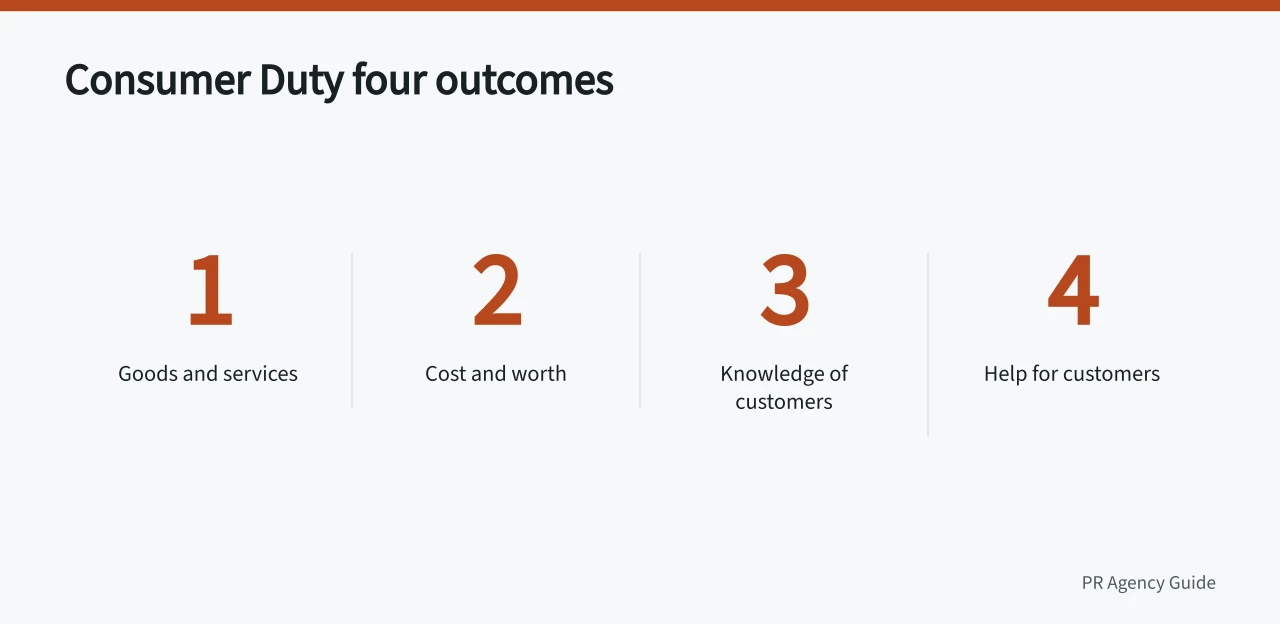
The consumer understanding outcome requires firms to support understanding so customers can make informed decisions. A promotion that a customer cannot understand undermines that outcome, even if it passes a narrow COBS 4.2 check. The two regimes overlap, and the stricter standard tends to win.
Consumer Duty PR work therefore needs a reader test, not just a legal test. Agencies should ask whether a typical customer would understand the promotion, the risks and the costs. If the answer is no, the copy needs work.
Consumer understanding in agency copy
Agency teams can support consumer understanding by testing copy with real readers; planning buyer interviews covers recruiting and running such sessions. A short comprehension test with a handful of retail customers can reveal problems before publication. The FCA expects firms to monitor and test understanding, not just assert it.
Agencies should also avoid dark patterns. A promotion that makes cancellation hard to find, or that buries a fee, conflicts with Consumer Duty even if the fee is disclosed somewhere. The overall customer experience is part of the assessment.
Price and value signals
PR copy often talks about value. Under Consumer Duty, a claim about value should be fair and supported. An agency should not write that a product is the cheapest without evidence the client can stand behind.
If the client cannot substantiate a comparative claim, the agency should drop it. Unsupported superlatives create both a Consumer Duty and an advertising checks problem.
Governance and evidence
Consumer Duty requires firms to have governance that tests outcomes. Agencies feed that governance by keeping evidence of what was tested and what changed. A record of a comprehension test, and the redraft that followed, is useful evidence.
Agencies should also flag when a client's brief pushes against Consumer Duty. A short written note raising the issue protects the agency and gives the client's compliance team something to act on.
Interaction with COBS 4
COBS 4 and Consumer Duty are not alternatives. A promotion must satisfy both. COBS 4 sets the communication standard. Consumer Duty sets the outcome standard. A promotion that is fair, clear and not misleading under COBS 4 may still fail the consumer understanding outcome if customers cannot grasp it.
Agencies working with retail banking clients should build both tests into the review. The pre-sign-off checklist below does that.
A pre-sign-off checklist for promotional copy
A pre-sign-off checklist gives the agency and the client a shared record of what was checked. It should be completed before the client signs off, not after. The checklist below covers the main FCA financial promotions points for bank work.
Pre-sign-off checklist
- Confirm it is a promotion
- Identify approver
- Check against COBS 4.2
- Reader can identify it as promotion
- Claims supported by evidence
- Test consumer understanding
- Record version, approver, date
The seven checklist items
- Status.Record whether the copy is a financial promotion and why, based on the call to action.
- Route.Record whether the client is authorised, the copy needs s21 approval, or an exemption applies. Name the approver and check the Financial Services Register.
- Fair, clear and not misleading.Test the copy against COBS 4.2.1R, with each qualification beside the claim it qualifies.
- Claims sourced.Attach a source and date for every rate, fee and comparison.
- Identifiable.Confirm that paid content is labelled so the reader can tell it is promotional.
- Consumer understanding.Run a comprehension test with real readers and record the redraft that followed.
- Approval record.Store the approver's written approval, the permission check, the locked final version and the signed checklist.
How to run the checklist
- The account lead opens the checklist at the start of the project and shares it with the client's compliance contact.
- The copywriter completes the first four items during drafting, not after.
- The compliance contact or approver completes the remaining items against the final copy.
- The account lead stores the completed checklist with the approval record.
- No item is left blank. If an item does not apply, the team records why.
A worked example
A London agency drafts a LinkedIn post for an unauthorised payments client. The post promotes a new prepaid card and ends with a sign-up link.
The agency identifies the post as a financial promotion. The client is unauthorised, so the agency arranges s21 approval through an authorised approver. The approver reviews the copy against COBS 4.2 and asks for the fee table to be moved above the fold.
The agency tests the revised copy with five retail readers. Two cannot find the monthly fee, so the fee moves into the main text. The approver signs off, and the agency records the version, the approver and the date.
What the checklist does not cover
A pre-sign-off checklist is not a legal opinion. It does not replace the client's own compliance process. It does not cover every exemption or every product type.
It also does not cover the ASA and CAP Code side of the work, which runs in parallel. Agencies should keep the two review tracks separate but aligned.
Common checklist failures
Three failures recur. The checklist is completed after publication, which defeats its purpose. The approver is named but their permission is never verified. The final version is not the version that was approved.
Each failure is fixable with a simple rule. Complete the checklist before sign-off. Verify the approver on the Financial Services Register. Lock the approved version and treat any later edit as a new approval.
Table: responsibilities across the approval chain
Responsibilities across the approval chain
| Step | Owner | Evidence to keep |
|---|---|---|
| Confirm promotion status | Agency account lead | Brief note with reasoning |
| Draft against COBS 4.2 | Agency copywriter | Draft versions and claim sources |
| Approve under s21 | Authorised approver | Written approval and permission check |
| Test consumer understanding | Agency and client | Comprehension test notes |
| Final sign-off | Client compliance | Signed checklist and final copy |
| Publish | Agency or client | Live URL and publication date |
Record keeping and the audit trail agencies must maintain
Record keeping requirements mean the agency can show what was published, who approved it and why it complied. The FCA expects firms to keep records of communications and approvals; SYSC 9 sets the general duty to keep adequate records. Retention periods vary by product and activity, so confirm the period with the client's compliance team. An agency that cannot produce the approved version is exposed if a complaint arrives months later.
Four-part audit trail
- Final approved copy
- Approval record with permission reference
- Evidence for every claim
- Completed checklist
- Live URL and screenshot
A useful audit trail has four parts: the final copy, the approval record, the evidence for claims and the checklist. Each part should be dated and stored where the client can retrieve it. A shared drive with version control is enough for most agencies.
Records should be kept for the period the client's own retention policy requires, and the agency should agree that period in the contract. If the client's policy changes, the agency should update its storage accordingly.
What to keep
Keep the final approved copy as a locked file or a PDF. Keep the approval email or form with the approver's name and permission reference. Keep the source for every factual claim, including rate tables and product terms. Keep the completed checklist.
Keep the live URL and a screenshot of the promotion as published. A page can be edited after publication, so the screenshot shows what the audience actually saw.
Version control
Version control is the weakest link in most agency files. A copy deck with tracked changes is better than a chain of emails. A single source of truth, with one owner, prevents the wrong version from going live.
Agencies should label versions clearly: draft, compliance review, approved, published. Any edit after approval should trigger a new approval, not a silent update.
Handling complaints and queries
If a complaint arrives, the agency should be able to produce the record within a short window. That means the record is indexed by client, campaign and date, not buried in a personal inbox.
Agencies should also keep a log of queries raised by the client's compliance team and how they were resolved. That log shows a working control environment and helps with the next campaign.
Working with the client's records
The client's own record keeping obligations sit with the client as the authorised firm. The agency's records support the client's file. The two should be consistent.
Agencies should agree at the start who holds the main record. If the client holds it, the agency still keeps a copy for its own protection. If the agency holds it, the contract should say how long and in what format.
Training and review
Records are only as good as the process behind them. Agencies should train account teams on the FCA financial promotions basics and review the checklist after each campaign. A short post-campaign review catches gaps before the next launch.
Agencies should also track changes to the FCA Handbook. COBS 4 and the approval gateway are not static. A quarterly check keeps the process current.
The UK framework around the FCA rules
FCA rules sit within a wider UK framework. The ASA and the CAP Code govern advertising content. The ICO and UK GDPR govern personal data in campaigns. The PRCA and CIPR set professional standards for agencies. Companies House holds corporate filings.
Agencies working across Greater London, Scotland, the West Midlands, Yorkshire and Wales should treat the FCA rules as the baseline for financial promotions.
The FCA Handbook COBS rules on financial promotions are the starting point, not the whole picture. Readers can find the wider UK legal boundaries in our guide to PR agency rules and ethics.
Common questions
Does an agency need FCA authorisation to write bank copy?
No, if the bank is authorised and approves its own promotions. The agency needs an s21 approver when the client is unauthorised and the copy is a financial promotion.
Who is liable if a promotion breaches COBS 4?
The authorised firm and the approver carry the regulatory responsibility. The agency can still face contractual liability, so the contract should set out who owns compliance sign-off.
Does Consumer Duty apply to agency copy?
Yes, where the client is a retail banking firm. The consumer understanding outcome applies to communications that support customer decisions, including agency-produced promotions.
How long should agencies keep approval records?
Follow the client's retention policy and agree the period in the contract. Keep the approved copy, approval record, claim evidence and checklist together.
Can a client's marketing manager approve copy?
Only if the client's own procedures give that person authority. The agency should confirm in writing who signs off compliance, and not assume a marketing approval is a compliance approval.
Does the CAP Code still apply to financial promotions?
Yes. The ASA and the CAP Code apply alongside the FCA rules. A promotion can breach both regimes, so agencies should run advertising checks as well as FCA checks.